

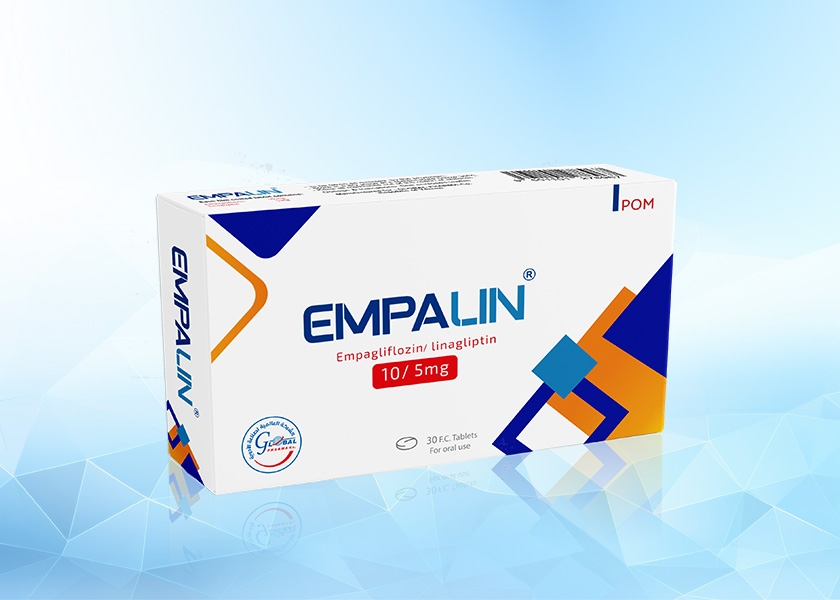

Indication
EMPALIN is added to metformin and/or sulphonylurea (SU) to treat type 2 diabetes in adult patients aged 18 years and older whose diabetes cannot be controlled when treated with metformin and/or sulphonylurea in combination with empagliflozin, or when treated with metformin and/or sulphonylurea in combination with linagliptin.
EMPALIN can also be used as an alternative to taking both empagliflozin and linagliptin as single tablets. To avoid overdose, do not continue taking empagliflozin and linagliptin tablets separately, if your are taking this medicine.
• It is important that you continue with your diet and exercise plan as told by your doctor,
pharmacist or nurse

Composition
;Each film-coated tablet of EMPALIN contains:
Empagliflozin/ Linagliptin 10 mg/ 5 mg.
Empagliflozin/ Linagliptin 25 mg/ 5 mg.

Dosage
Always take this medicine exactly as your doctor has told you. Check with your doctor or pharmacist if you are not sure.
The usual starting dose is one film-coated tablet of EMPALIN 10 mg/5 mg (10 mg
empagliflozin and 5 mg linagliptin) once a day.
-Your doctor will decide whether you need to increase your dose to one film-coated tablet
of EMPALIN 25 mg/5 mg (25 mg empagliflozin and 5 mg linagliptin) once a day.
If you already take 25 mg empagliflozin and 5 mg linagliptin as separate tablets and you switch to EMPALIN
you can start directly with EMPALIN 25 mg/5 mg.
- Taking this medicine:
• Swallow the tablet whole with water. •
You can take EMPALIN with or without food.
• You can take the tablet at any time of the day.However, try to take it at the same time each day.This will help you to remember to take it.
• Your doctor may prescribe EMPALIN together with another anti-diabetic medicine.
• Appropriate diet and exercise help your body to use its blood sugar better. It is important to stay on the diet and exercise program recommended by your doctor while taking EMPALIN
• This medicine is not recommended for children and adolescents under 18 years as linagliptin is not effective in children and adolescents between the ages of 10 and 17 years. It is not known if this medicine is safe and effective when used in children younger than 10 years
This medicine contains two active substances Empagliflozin and Linagliptin.
Each belongs to a group of medicines called “oral anti-diabetics”. These are medicines taken by mouth to treat type 2 diabetes.
;Each film-coated tablet of EMPALIN contains:
Empagliflozin/ Linagliptin 10 mg/ 5 mg.
Empagliflozin/ Linagliptin 25 mg/ 5 mg.
EMPALIN is added to metformin and/or sulphonylurea (SU) to treat type 2 diabetes in adult patients aged 18 years and older whose diabetes cannot be controlled when treated with metformin and/or sulphonylurea in combination with empagliflozin, or when treated with metformin and/or sulphonylurea in combination with linagliptin.
EMPALIN can also be used as an alternative to taking both empagliflozin and linagliptin as single tablets. To avoid overdose, do not continue taking empagliflozin and linagliptin tablets separately, if your are taking this medicine.
• It is important that you continue with your diet and exercise plan as told by your doctor,
pharmacist or nurse
Do not use if you are allergic to empagliflozin, linagliptin, any other SGLT2 inhibitor , any other DPP‑4 inhibitor, or any of the other ingredients of this medicine
If you are pregnant, think you may be pregnant or are planning to have a baby, ask your
doctor for advice before taking this medicine. It is not known whether
EMPALIN is harmful to the unborn child. As a precautionary measure it is preferable to avoid the use of this medicine during pregnancy.
It is not known whether the active substances of
EMPALIN pass into human breast milk.
Do not use this medicine if you are breast-feeding
Like all medicines, this medicine can cause side effects, although not everybody gets them. Contact a doctor or the nearest hospital straight away if you have any of the following side effects:
Diabetic ketoacidosis, seen rarely (may affect up to 1 in 1000 people).
These are the signs of diabetic ketoacidosis see also section (1) Warnings and precautions. This may occur regardless of blood glucose level. Your doctor may decide to temporarily
or permanently stop your treatment with this medicine.
Contact your doctor immediately if you notice any of the following side effects:
Allergic reactions, seen uncommonly (may affect up to 1 in 100 people)
This medicine may cause allergic reactions, which may be serious, including hives (urticaria) and swelling of the face, lips, tongue, and throat that may cause difficulty in breathing or swallowing (angioedema).
Inflammation of the pancreas (pancreatitis), seen uncommonly
This medicine may cause pancreatitis, which usually shows as persistent, severe abdominal (stomach) pain that might reach through to your back, often accompanied by feeling sick or being sick. Your doctor will need to change your treatment.
Low blood sugar (hypoglycaemia), seen commonly (may affect up to 1 in 10 people)
If you take
EMPALIN with another medicine that can cause low blood sugar, such as a sulphonylurea or insulin, you are at risk of getting too low blood sugar (hypoglycaemia). The signs of too low blood sugar may include
Always take this medicine exactly as your doctor has told you. Check with your doctor or pharmacist if you are not sure.
The usual starting dose is one film-coated tablet of EMPALIN 10 mg/5 mg (10 mg
empagliflozin and 5 mg linagliptin) once a day.
-Your doctor will decide whether you need to increase your dose to one film-coated tablet
of EMPALIN 25 mg/5 mg (25 mg empagliflozin and 5 mg linagliptin) once a day.
If you already take 25 mg empagliflozin and 5 mg linagliptin as separate tablets and you switch to EMPALIN
you can start directly with EMPALIN 25 mg/5 mg.
- Taking this medicine:
• Swallow the tablet whole with water. •
You can take EMPALIN with or without food.
• You can take the tablet at any time of the day.However, try to take it at the same time each day.This will help you to remember to take it.
• Your doctor may prescribe EMPALIN together with another anti-diabetic medicine.
• Appropriate diet and exercise help your body to use its blood sugar better. It is important to stay on the diet and exercise program recommended by your doctor while taking EMPALIN
• This medicine is not recommended for children and adolescents under 18 years as linagliptin is not effective in children and adolescents between the ages of 10 and 17 years. It is not known if this medicine is safe and effective when used in children younger than 10 years
Talk to your doctor, before taking this medicine, and during treatment:
If you have “type 1 diabetes”. You should not take EMPALIN if you have type 1 diabetes.
• If you experience rapid weight loss, feeling sick or being sick, stomach pain, excessive thirst, fast and deep breathing, confusion, unusual sleepiness or tiredness, a sweet smell to your breath, a sweet or metallic taste in your mouth, or a different odour to your urine or sweat, contact a doctor or the nearest hospital straight away and stop taking this medicine until further advice from your doctor. These symptoms could be a sign of “diabetic ketoacidosis” – a rare, but serious, sometimes life-threatening problem you can get with diabetes because of increased levels of “ketone bodies” in your urine or blood, seen in tests. The risk of developing diabetic ketoacidosis may be increased with prolonged fasting, excessive alcohol consumption, dehydration or sudden reductions in insulin dose, or a higher need of insulin due to major surgery or serious illness.
•If you are taking other anti-diabetic medicines known as sulphonylurea and/or using insulin. •If you have or have had a disease of the pancreas.
•If you have serious kidney problems. Your doctor may limit your daily dose.
•If you have serious liver problems. Your doctor may ask you to take a different medicine.
•If you might be at risk of dehydration, for example: if you are being sick, have diarrhoea or fever, or if you are not able to eat or drink, if you are taking medicines that increase urine production [diuretics] or lower blood pressure, if you are over 75 years old. Your doctor may ask you to stop taking
EMPALIN until you recover to prevent loss of too much body fluid.
•If you have an increase in the proportion of red blood cells in your blood (haematocrit), seen in laboratory blood tests
Contact your doctor if you experience any of the following during treatment with EMPALIN
•If you develop symptoms of acute pancreatitis, like persistent, severe stomach ache (abdominal pain). Your doctor may need to change your treatment.
If you have a serious infection of the kidney or the urinary tract with fever. Your doctor may ask you to stop taking EMPALIN
until you have recovered.
• if you encounter blistering of the skin it may be a sign for a condition called bullous pemphigoid. Your doctor may ask you to stop EMPALIN
.
Kidney function
During treatment with this medicine, your doctor will check your kidney function at least once a year or more frequently if you are elderly and/or if you have worsening kidney function.
Foot care
Like for all diabetic patients it is important to check your feet regularly and adhere to any other advice regarding foot care given by your health care professional.
Urine glucose
Because of how this medicine works, your urine will test positive for sugar while you are taking this medicine.
EMPALIN 10/5 Tablets (Blister of 10 Tablets, Pack of three blisters
Store in a dry place at a temperature below 30ºC. • Keep out of the reach of children.